

Fundamentals of the Brazing Process
During the brazing process, a brazed joint is formed by the filler metal melting and flowing via a capillary effect into the pores of the closely fitted surfaces of the joint to form an alloy of the metals upon solidification.
The key to successfully achieving a good brazed connection is surface preparation. The presence of contaminants or oxides prevents the filler metal from coming into contact with one of the surfaces to be brazed. In the case of minor oxidation, the pores of the surfaces to be brazed will be sealed by the oxide. This prevents the capillary action and, ultimately, the brazing from occurring. Hence, the initial cleanliness of the surfaces to be brazed is extremely important, but it is equally important that the cleanliness of these surfaces be maintained during the process.
Achieving and maintaining the necessary level of cleanliness is much more difficult for brazing stainless steel components than brazing steel components. The Chromium in the stainless steel forms a much more stable oxide at a much lower Oxygen level than iron.
The oxides present on the surface must be reduced prior to the part reaching the melting temperature of the filler metal. The reduction is typically achieved through a reaction of Hydrogen with the Oxygen present in the oxide to form water vapor.
The presence of too much water vapor or Oxygen in the system will prevent the reaction from proceeding. The dew point is used to determine the amount of water vapor in the system at given conditions. The dew point is the temperature at which an amount of water vapor in the system will saturate the atmosphere. The typical dew point required for brazing stainless steel joints in 100% Hydrogen is –50º F.
BRAZING FUNDAMENTALS DIAGRAM

Figure 1.
Brazed Stainless Steel Components

Figure 2.
Brazing Schematic

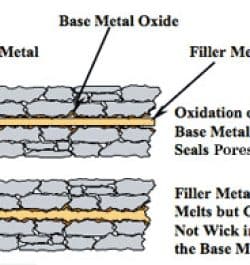
Figure 3.
Effects of Oxidation on Brazing


Figure 4.
Oxide Stability

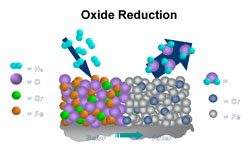
Figure 5.
Oxide Reduction Mechanism


Figure 6.
Dew Point Requirements
TYPES OF BRAZING FURNACES
- Continuous Brazing Furnace
- CAB Furnace (Controlled Atmosphere Brazing)
Resources and articles related to Brazing Furnaces
Industrial Heat Treatment Furnace Guide
Heat-treating is using rapid heating and cooling to alter the physical or chemical properties of metal or other substances. This is usually done to improve the metal’s hardness, strength, or ductility, but heat-treating can also be used to remove residual stress and increase wear resistance. Processes that rely on heat treatment include brazing, tempering, annealing, case hardening, normalizing and sintering.
A Guide to Industrial Furnace Features and Types
The configuration of equipment and engineering that goes into a furnace impact the quality of the parts coming out. Here are the basics you need to know.
A Guide to Industrial Furnace Maintenance
Is your furnace running smoothly? If not, this guide will help you troubleshoot any maintenance problems that may arise in your industrial furnace.


